
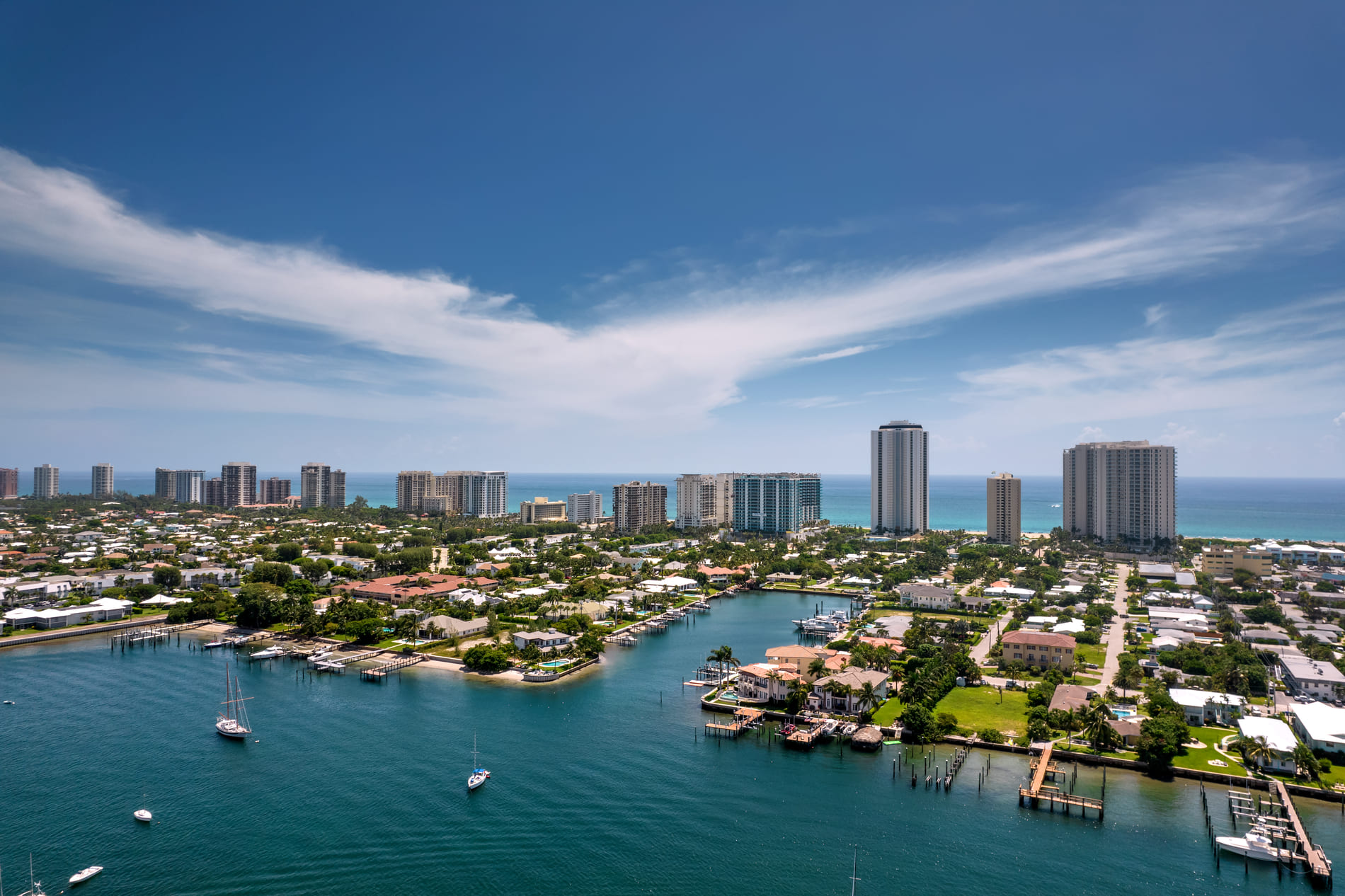
Singer Island has some of the best oceanfront condo inventory in Palm Beach County, and also some of the highest financial risk for buyers who skip due diligence. Florida's post-Surfside condo laws (SB-4D in 2022 and subsequent amendments through HB 1021 in 2024) changed the rules for buying any condo building three stories or taller, and buildings near the coast face shorter inspection timelines. Singer Island sits in the highest-stakes version of this market: a barrier island, mostly buildings 30 to 60 years old, all of them oceanfront or near-oceanfront, and all of them now subject to inspections and reserve requirements that older HOA budgets did not anticipate.
This guide covers what serious Singer Island condo buyers need to verify before going firm. It is written for buyers who plan to write a real check, not for browsers. If you are evaluating Singer Island as one of several Palm Beach County options, the framework below tells you which questions actually matter.
Where Singer Island Is and What Oceanfront Actually Means There
Singer Island is a barrier island in northern Palm Beach County, technically split between Riviera Beach and the Town of Palm Beach Shores at the southern tip. The island runs north-south, with the Atlantic Ocean to the east and the Intracoastal Waterway (Lake Worth Lagoon) to the west. Total length is roughly three miles. The mainland communities directly adjacent to Singer Island include North Palm Beach to the north and West Palm Beach to the south and west across the Intracoastal.
This geography creates three distinct buying categories:
Direct oceanfront condos sit on the east side of A1A with frontage on the Atlantic. The premier inventory. Views, ocean breeze, beach access, and the highest pricing.
Intracoastal-side condos sit on the west side of A1A with frontage or proximity to the Lake Worth Lagoon. Often boating-oriented, sometimes with marina or dock access, generally less expensive than oceanfront. Buyers considering boating-focused waterfront in Palm Beach County may also look at single-family waterfront further north; our Martin County waterfront homes guide covers that alternative market.
Interior condos sit between the two and do not have direct water frontage. Usually the most affordable inventory on the island and an entry point for buyers who want the Singer Island lifestyle without the oceanfront premium.
Within "oceanfront," there is further variation between direct beachfront (the building sits on the dune), ocean-view (the building has ocean views from upper floors but does not occupy beach frontage), and partial-view (some units have ocean views, some do not). Listing copy uses these terms loosely. Verify what the actual unit you are buying actually has, not what the building description suggests.
The Milestone Inspection Reality (SB-4D)
Florida Senate Bill 4D, passed in 2022 after the Champlain Towers South collapse in Surfside, requires "milestone inspections" of condo buildings three stories or taller. The basic framework:
-
Most buildings: milestone inspection required at 30 years
-
Buildings within three miles of a coastline (which includes most of Singer Island): milestone inspection required at 25 years
-
Recurring milestone inspections every 10 years after the initial inspection
The inspection happens in phases. Phase 1 is a visual inspection by a licensed engineer or architect to assess the structural condition. If Phase 1 finds substantial structural deterioration, a Phase 2 inspection is required, including destructive or invasive testing as needed. Phase 2 findings can trigger immediate repair requirements.
What this means for Singer Island buyers: most buildings on the island have completed or are completing their initial milestone inspections, and the results are a critical part of the condo doc package. A clean Phase 1 inspection is a strong positive signal. A Phase 1 that triggered Phase 2 testing, or a Phase 2 that identified required repairs, is information that should affect your offer or your decision to walk.
Always read the actual inspection report, not the HOA's summary of it. The summary will tell you what the board wants you to know. The report will tell you what the engineer actually found.
Structural Integrity Reserve Study: What to Demand
The second pillar of the post-Surfside law is the Structural Integrity Reserve Study (SIRS), required every 10 years for buildings three stories or taller. The SIRS identifies the major structural components of the building (roof, structural slabs, waterproofing, electrical, plumbing, fire safety, windows and exterior doors above a certain cost threshold, and any other items costing $10,000 or more to replace) and projects their useful life and replacement cost.
The HOA then must fund reserves to cover those projected replacements, with limited ability to waive reserve funding compared to the prior law.
What this means in practice: older Singer Island buildings that historically ran lean on reserves (low HOA fees, deferred maintenance, special assessments when something broke) are now legally required to build reserves to fund the SIRS projections. This is the single largest source of HOA fee increases on Singer Island over the past three years, and the source of most large special assessments.
Before going firm on a Singer Island condo, demand to see:
-
The most recent SIRS report in full
-
The current reserve study (different from SIRS in some buildings)
-
The current year's HOA budget showing how reserve funding compares to the SIRS projection
-
Any reserve funding shortfalls and the board's plan to close them
A building with a fully-funded SIRS and reserves trending up is in good shape. A building with a SIRS projecting $8 million in upcoming replacements and $1.2 million in actual reserves is going to assess. That math is unavoidable, and the assessment will land on the owner of record when the board calls it.
The Condo Doc Review: What's Really In There
Florida law requires sellers to provide a condo doc package to buyers, and buyers have a right of rescission for a defined period after receipt. Read these documents carefully or pay a real estate attorney to read them for you.
The package typically includes:
|
Document |
What to Look For |
|
Declaration of Condominium |
Use restrictions, unit boundary definitions, what is "common element" vs unit |
|
Bylaws |
Voting rights, board composition, owner rights |
|
Articles of Incorporation |
Corporate structure of the association |
|
Current Year Budget |
Operating costs, reserve contributions, what is funded and what is not |
|
Most Recent Financial Statement |
Actual financial condition of the HOA |
|
Reserve Study and SIRS |
Projected major replacements and funding status |
|
Milestone Inspection Reports |
Structural condition of the building |
|
Recent Meeting Minutes (typically 12 months) |
What the board is actually working on |
|
Insurance Master Policy |
What the building's master policy covers and what unit owners need |
|
Special Assessment History |
Recent assessments and what they funded |
|
Pending Litigation |
Active lawsuits involving the association |
Three documents in this list catch problems that the others miss. Recent meeting minutes show what the board is genuinely worried about, which is often different from the marketing pitch. Pending litigation can signal serious financial exposure. The insurance master policy tells you whether the building's wind coverage, flood coverage (where applicable), and liability limits are adequate for the actual replacement cost of the building.
Skipping any of these documents is a mistake. We have walked buyers away from beautiful units because the meeting minutes revealed an unresolved $4 million roof issue the listing agent neglected to mention.
Insurance on Singer Island Oceanfront Condos
Three insurance layers apply:
The building's master policy is the HOA's responsibility and covers the structure, common elements, and association liability. Master policy premiums for Singer Island oceanfront buildings have risen dramatically over the past five years, particularly for older buildings and buildings without current wind mitigation certifications. The master premium directly affects the HOA fee.
Unit owner HO-6 policy covers the inside of the unit (anything from the drywall in, fixtures, personal property, loss of use, and unit-owner liability). HO-6 premiums on Singer Island vary by unit size and coverage limits, typically running $1,500 to $4,000+ per year.
Flood insurance is required by lenders for units below certain elevations in FEMA-designated flood zones, and is highly recommended for any ground-floor or low-elevation unit even when not required. NFIP flood policies cover $250,000 building / $100,000 contents maximum; private flood policies can offer higher limits at varying cost.
Get specific quotes during the inspection period. Insurance reality on Singer Island can add $5,000 to $15,000+ per year to the total cost of ownership beyond the HOA fee, and that number changes year to year as the Florida insurance market shifts.
HOA Fees: What They Cover and Why They Vary
Singer Island HOA fees span a wide range, broadly $700 to $3,000+ per month depending on building age, amenities, master policy cost, reserve funding, and unit size.
Higher-end buildings include 24-hour concierge, valet, fitness center, multiple pools, beach service, club room dining, and full property management. Older or simpler buildings include pool, basic security, common area maintenance, master insurance, and elevators.
The fee covers the master policy, building staff, building maintenance, reserves, and amenities. It does not cover the unit owner's HO-6 policy, flood policy, utilities inside the unit, or any unit interior maintenance.
The most important number is not the fee itself but the trajectory. A $1,200/month fee that has been $1,200 for five years and projects flat for the next three years is very different from a $1,200/month fee that was $850 three years ago and projects $1,500 next year. Ask for the fee history and the projection.
Singer Island Condo Eras: How Year Built Changes Everything
|
Construction Era |
Typical Buildings |
Key Buyer Considerations |
|
1960s-1970s |
Older mid-rise oceanfront, some Intracoastal |
Milestone inspection critical, reserve funding catch-up, often the best value but highest due diligence load |
|
1980s |
Many of the iconic Singer Island towers |
Past initial milestone inspection by now, SIRS shaping current reserve increases |
|
1990s |
Mid-rise and high-rise, more concrete |
Generally better-engineered, milestone inspection coming or recently completed |
|
2000s-Pre-2007 |
Post-Andrew building code, impact glass standard |
Strong wind performance, generally lower insurance, newer infrastructure |
|
Post-2010 |
The Resort at Singer Island, Ritz-Carlton Residences, newer luxury inventory |
Highest construction standards, newest reserve studies, highest pricing |
A 1970s building is not automatically a bad buy. Some of them have been beautifully maintained, have funded reserves, and have completed milestone inspections cleanly. They can be the best value on the island for buyers willing to do the due diligence. A 1970s building with deferred maintenance and a thin reserve is a different proposition entirely.
Rental and Pet Restrictions: Read the Declaration
Singer Island building rules on rentals vary widely. Some buildings allow weekly rentals, some require minimum 30-day rentals, some require 90-day or 6-month minimums, and some prohibit rentals entirely for a defined ownership waiting period (commonly 1 to 2 years from purchase).
Buyers planning to use the unit as a short-term rental investment need to verify rental rules before contracting. Buildings with restrictive rental policies tend to attract long-term residents and have a different feel than buildings with active short-term rental programs. Neither is better. They are different products.
Pet rules also vary, with most buildings allowing pets up to a weight limit and some restricting the number of pets or the breeds. If a pet is a non-negotiable part of your life, verify in writing before going firm.
What Most Singer Island Buyers Miss
Three things consistently show up after closing for buyers who did not catch them in due diligence:
First, the difference between the listed HOA fee and the all-in cost. A $1,200 monthly HOA fee on top of $8,000 annual insurance, $3,500 annual property taxes (assuming $500K assessed value), and unit maintenance is closer to $30,000 per year in carrying costs before debt service. Make sure the math works on the way in. Many Singer Island buyers are also purchasing as a second home or seasonal residence, which adds another layer of tax considerations specific to Florida second-home buyers that affect the real cost of ownership.
Second, the assessment timing risk. A milestone inspection in progress is a known risk. A milestone inspection scheduled for 18 months from now is a different kind of risk, because the findings have not happened yet and the assessment is unpriced. Buyers in this situation should price the unknown into the offer or wait until the inspection completes.
Third, the parking reality. Many older Singer Island buildings have fewer parking spaces than units, with deeded parking spaces selling separately or assigned by rotation. A unit "with parking" might mean one assigned space in a covered garage; it might mean a numbered spot in an outdoor lot; it might mean access to a guest lot without an assigned space. Verify exactly what the unit conveys.
Working With a Singer Island Specialist
Singer Island is a market where reading condo docs correctly changes the outcome of the transaction. We work this inventory regularly, we know which buildings have current milestone inspections in good standing and which do not, we know which boards run their associations well and which have ongoing disputes, and we know which assessments are coming. Reach out to Zach Greenberg and our team at Coastal Real Estate Pros to start a focused search built around your budget, your use case, and your risk tolerance.
Frequently Asked Questions
What is a Milestone Inspection and why does it matter on Singer Island?
A milestone inspection is a structural assessment required by Florida law (SB-4D, 2022) for condo buildings three stories or taller, with the first inspection due at 25 years for buildings within three miles of a coast and 30 years inland. Recurring inspections happen every 10 years. The inspection determines whether the building has substantial structural deterioration requiring repair. On Singer Island, where most buildings are 30 to 60 years old and within a few hundred feet of the ocean, milestone inspections are the most important single document in any condo doc review.
What is the Structural Integrity Reserve Study (SIRS)?
The SIRS is a study required every 10 years for condo buildings three stories or taller. It identifies major structural and infrastructure components, projects their useful life and replacement cost, and informs the reserves the association must fund. SIRS-driven reserve funding is the largest source of HOA fee increases and special assessments on Singer Island in the current market. A well-funded SIRS is a positive signal; a SIRS with a large funding gap means assessments are coming.
How long do I have to review condo documents after a contract is signed?
Florida law provides a defined right of rescission for condo buyers after receipt of the condo doc package. Use that time fully. Read everything, ideally with a Florida real estate attorney for any significant purchase. The cost of an attorney review is a fraction of one month of HOA fees, and the protection is real. We coordinate this for buyers in every Singer Island transaction.
Are special assessments common on Singer Island?
They have been common over the past five years as buildings absorb the cost of milestone inspections, SIRS-driven reserve catch-ups, and rising insurance premiums. The risk is not random. It correlates closely with building age, reserve funding history, and inspection findings. Reading the SIRS and reserve study tells you whether a specific building is likely to assess in the next few years.
Can I rent out a Singer Island condo as a short-term rental?
Some buildings allow it, many do not, and some require a minimum ownership period before any rentals are permitted. The Declaration of Condominium and the building rules govern this, not the local zoning code. Verify rental rules in writing before contracting if rental income is part of the plan. Investment-grade rental buildings and primary-residence buildings on Singer Island operate as essentially different markets.
Is Singer Island more expensive than other Palm Beach County oceanfront markets?
Singer Island is generally less expensive per square foot than Palm Beach proper and comparable to Jupiter Island for direct oceanfront, while offering more inventory across more price points. The condo-dominant market on Singer Island also means lower entry pricing than the single-family-home markets on Jupiter Island or Palm Beach. For oceanfront living in Palm Beach County, Singer Island remains one of the more accessible markets for buyers at $800,000 to $3 million, with luxury options above that.
How do hurricanes affect Singer Island condos?
Singer Island is exposed to direct hurricane impacts as a barrier island. Modern construction (2000s and later) generally performs well, with impact glass and reinforced structural systems. Older buildings have varying levels of post-Andrew upgrades. Insurance costs reflect this exposure. Buildings with current wind mitigation certifications carry lower master premiums, and units with impact glass certifications carry lower HO-6 premiums. Verify both during due diligence.
Posted by Zach Greenberg on
Enjoy this blog post? Click here to subscribe for updates
Leave A Comment